Monday, July 19, 2010

The Cape Route

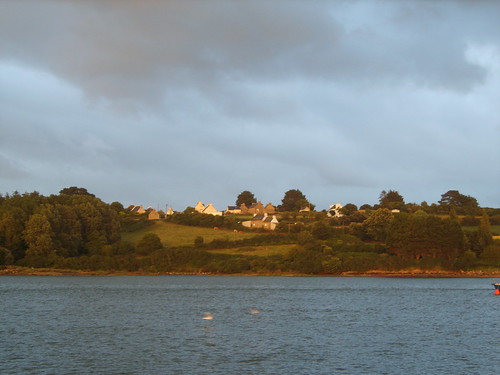
Exactly a week after leaving Jersey, we finally made it to Brest. South Westerly winds, a Southerly storm force 9 and seaweed contrived to keep us from getting West. We spent three days near Tréguier waiting for the weather to improve, playing Colonists of Catan and visiting the bar on shore for ice cream. It's called Pesked and is very picturesque and they have good mussels. The oysters, however, may have had something in them as all of us got sick two days after eating them.

S8003574

Once we got going, the North Westerly the forecast promised turned out to be rather Westerly, so no good progress was made and lots of diesel used. After the tide turned in favor for us, the waves got even higher so we made a short stop to sleep somewhere near Morlaix. After the wind and tide turned again, we left to make for Ouessant.

The wind was North Westerly at last, but it didn't last. After two hours, we were beating into a Westerly again and the engine stayed on for the next 12 hours. We had just rounded Portsall on the outer tip of Brittany, when a big field of sea weed got pulled into the propellor and stalled the engine. Just prior to it dying, I got it out of gear and now we were stuck with a prop full of weed and neither forward or reverse made it come free. So we stopped the engine.

Now we were drifting slowly towards the rocky passage of the Chenal Du Four, with hardly a Force 2 South Westerly and no engine. But as we tried gaining speed, the prop started turning along. So we tried starting the engine and it worked, but only forward. So we made for Camaret at slow speed. By 6 a.m. I tied to a buoy in the bay of Camaret and later, dove to free the prop from a thick layer of weed.

Later that day, I sailed the boat with two sick crew and a rather bad lack of sleep to Brest, where we moored next to the visitors pontoon at 5 p.m.

We were in Brest, and ready for the first big crossing.

Monday, July 12, 2010

South, always South.

It's been a roller coaster ride up till now. Our departure was delayed due to bad weather, but on Monday evening we finally left.

S8003546

Lots of family and some friends made it to wave us goodbye, for which my thanks!

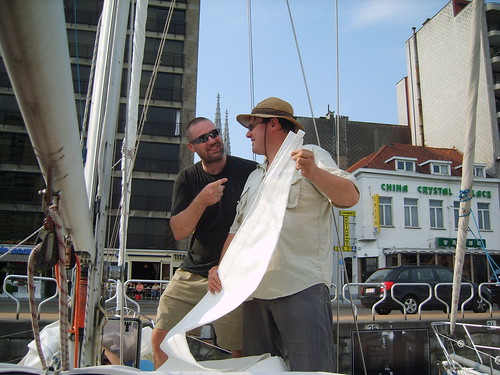
We set off with 6 crew, Troy and Helen from China, Ines and Tony from Belgium and Ingrid and me, obviously. Our first evening and night was uneventful, we sailed and motored and soon we were past Calais and getting some distance between us and the traffic system. Helen, unfortunately, was never without sea sickness. She managed to get some sleep in between of her exhausting dizziness, but could hardly eat or drink. After a rough night on the third day, on which we stopped over at Omonville-la-Rogue, just past Cherbourg, a decision was made.

Troy and Helen would get off the boat at St. Helier, on Jersey. This would put me two crew short for the Biscay crossing. Since this was already the 8th of July, it would be difficult to find new crew for the next part. So once we made it to St. Helier, I got busy with internet connections, e-mail and contacts I made earlier while looking for crew.

After a nice day at St. Helier, we left the following morning - or so we thought. Upon starting the engine, nothing happened. This was a first, and with only 30 minutes before the tidal gate shut, a tough decision was made to get a mechanic in order to make it for the next tide.

An hour later, a robust man showed up, said hi and jumped into the engine room. After a minute or so, he said to start the engine, got into the other side and said start her now. And at the first turn of the switch, she started! It turned out a wire had come loose from the starter motor. 10 Euros later, we were a happy crew again and the rest of the morning was spent in laziness.

Getting to St. Malo in Brittany was easy enough, although now we had to make the approach in the dark, as we couldn't start in Jersey until 4 p.m. But with the help of our trusted chart plotter, we got in alright and at 4 a.m. the next morning, tied on to the last available berth. We got around the Cherbourg promontory alright, although with 2 crew members less than planned.

Thursday, July 1, 2010

Day One: crew arrival

It's still a big mess to sort out, but we're getting closer. Six people loaded 360 bottles of mineral water onto a 36 foot yacht. There are some nice mathematical remarks to be made about that. There is now some less space on the boat, especially in the lazarette. But that was always too big and easy to lose stuff in. A lot of the stuff that resided in it, is now sitting in the cockpit, so a nice challenge there to get rid of it all - or at least a lot of it.

And we still have some more equipment coming today, sails and a generator and diving gear. But everything will fit in there at some time so today I'll do some sorting out of all that's not where it should be.

Also today, two people of our departing crew are arriving. They will be staying until Portugal, so it's nice to meet Helen and Troy face to face at last. The other two crew we've already met, tomorrow everybody will be together and we'll see what happens.

Last week, I got all the odd ends sorted so the boat is ready to go and so am I. There still will be the usual pre-departure stowing and cleaning, but today, a good year has already begun!

Sunday, June 13, 2010

Set it all up, then switch off.

It's been in planning a while, and a lot of things had to be organized for the solar panels to be mounted. I started with a simple radar and antenna pole which came with the boat.

radarpaal
I needed plenty of solar power so the pole had to go. Two large panels were to be sited at the aft of the boat. But the radar had to get in as well, plus the antennae, and I wanted a solution which didn't obstruct a wind vane and hold a dinghy in davits.
panel1
So I got a welder to draw me a design, and then I changed it because it became hugely expensive, and then I had to wait for hours for them to show up and actually work on it.
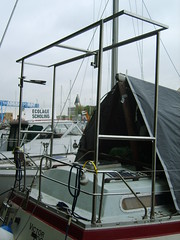
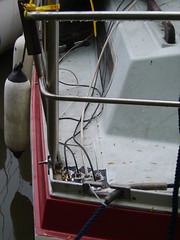
This is the basic shape, with a detail of the new wiring:
arch1arch2
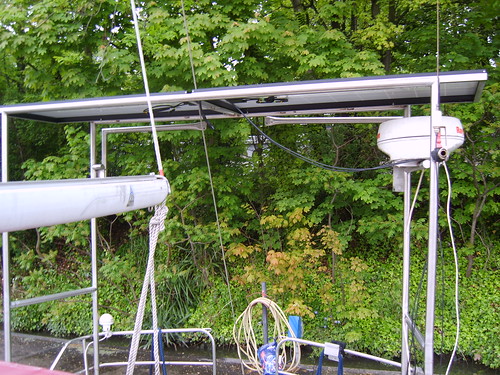
And after we mounted the panels, the radar, the antennas and the davits it sort of looked like this:

arch3

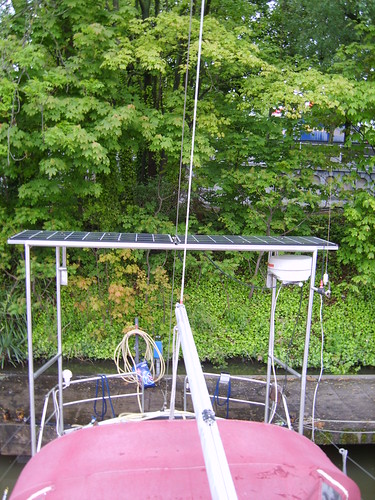
From the top, you can see the solar panel surface is quite huge:

arch4

Next up were three service batteries to replace the existing two. We now have 300 Ah in battery power and 270 Wp in solar power. I've got an emergency 1100 Watts back-up generator and the new alternator regulator, so it's hard to imagine us ever being out of power.

And we'll need it to power all our gizmos such as two portable PC's, satellite phone, instuments and lights, fridge and chart plotter. I've spent the day yesterday setting up the main navigation portable with maps and software. It'll take some tweaking and tuning to get it all up and running. I hope I can get away from it all once it's set up.

That'll be the real challenge of this trip: switching everything off every now and then and enjoy the places we visit.

Sunday, May 9, 2010

Look outside

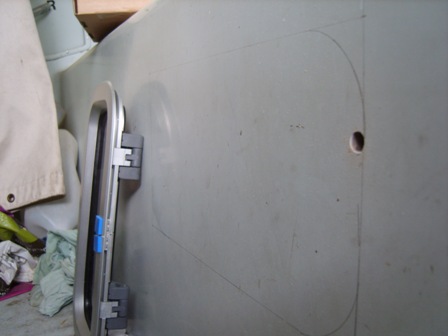
Another week end, another step. Every week end sees us advancing slowly but this Sunday I added a portlight to the walk through from the saloon to the aft cabin. To ensure ventilation, one hatch is a bit meager so a new portlight was the answer.

First I took very accurate measurements, as cutting large holes in the outside of a boat is never done without precautions.

voor

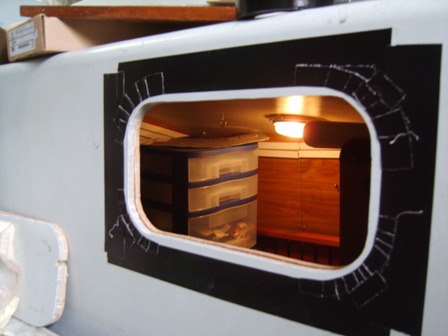
After drilling a pilot hole and double checking its position, I cut a large hole with a circular saw.

tijdens

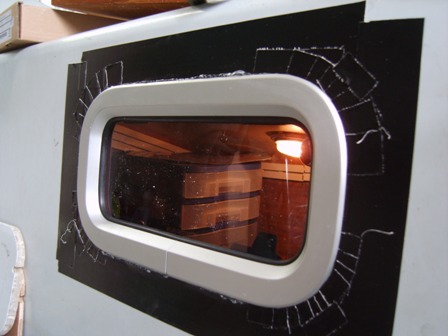
Next was the masking of the area around the portlight for excess mastic. I always take good care in this stage, as a well masked area makes the job so much easier.

na

The fitting of the portlight was quite easy, and now we have some natural light in the walk through as well as better ventilation in the aft cabin. An added benefit is a way of talking from the chart table to the steering position. Sound transmission was always much better from the outside, I hope it is now possible to hear someone on the inside.

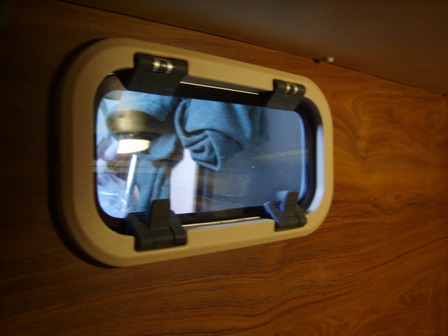
After cutting the inside frame with scissors, the finish looks quite professional.

binnen

I also started wiring the solar panel array, and I hope to have this finished by next Friday with some pictures.

Monday, April 12, 2010

Prep work

We had some fine weather this week-end, so we got to do some work on the outside. It wasn't very hot but there was some sun instead of the usual rain, sleet and snow we've been having the last months.

So on Saturday, we went out and measured the exact location of the wind vane supports. It took some doing and re-doing as both inside and out there were some obstacles. But finally, we got it right as you can see in this picture:

Measuring the vane

Next were the backing plates. After drilling pilot holes, on the inside one location out of three had landed where a reinforcement was already in place. So two more reinforcements were needed. I put those in place on Sunday, while Ingrid was cleaning fenders and taking off the last layers of varnish from the hand-holds. There are now no more varnished surfaces outside, apart from the companionway. We like the natural teak look better and it doesn't flake as quickly.

After I epoxied the pieces in place, I added a few layers of fiber cloth and epoxy for an even load distribution. Hopfully, next week work will start on the arch, so I can start finishing the vane construction soon.

Monday, March 22, 2010

All engine systems go!

I felt an absolute grease monkey this week-end. I spent a lot of time doubled up and lying face forward through the starboard engine hatch, squeezed through the hatch with both arms.

The positive news is, the engine is now running again, with a new raw water pump and a new alternator regulator and new brushes. On the minus side, I'm still a bit stiff from laying in the lazarette with my legs bent back over my head.

I first replaced the old raw water pump with a new one. I was never too happy with the pump as it required constant attention, adjustment, grease and it still dripped salt water from time to time. So I enquired into replacements and learned that a new, identical pump was hugely expensive and I'd still have an old design.
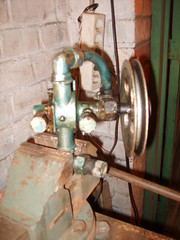
water pump t90 old the old pump aka "grease guzzler"

So I tried to find alternatives and the people at ASAP got me a Johnson pump which required minimal adjustments. The new pump did have slightly different measurements, mostly to do with the entry and exit being 3/4 inch instead of 1/2 inch. So I got some basic connections from my local plumbing supplier. I had the pulley machined to a slightly larger bore (1 mm extra) and I now have a brand new, non leaking pump.
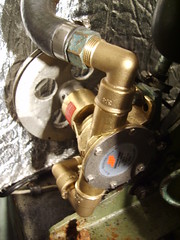
water pump t90 new

Once this was finished, the engine would run so I could continue work on the engine alternator.

I had ordered the Sterling advanced alternator regulator as I had experienced I never got the service batteries quite to 100% full. The shore power charger is a 10A DIY jobbie which is good at topping up, but it never really bulk charges or deliver the final charge modern chargers can. A new shore charger is on the wish list, but not that high as we'll be spending a year away from marinas, so shore power availability will be limited.

The engine alternator is 35 Amps, and as long as we motor for several hours and the battery state is not too badly discharged, it has the capacity to keep the batteries topped up. But the in-built regulator is a simple device, and as the batteries got older, charging them got more difficult and lengthy, even when motoring for longer spells.

I would have preferred a heavier alternator, but that would have meant a different pulley set-up. And I just bought 270 Watts in solar panels, so any alternator power would be an extra. The main thing is getting the batteries charged as rapidly as possible with the existing one. So I got the regulator as it promises to use all 35 Amps in bulk setting.

I installed the regulator, which meant disconnecting the alternator twice while doing checks and adjustments between them.
After taking the alternator out, I checked for wear and found a brush needed replacement. It took an alternator builder two weeks to get the Lucas brushes from Italy. I then connected check wires to the brushes. They are the yellow wires in the picture.
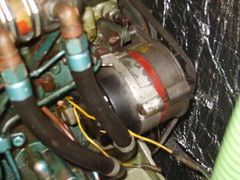
alt check wires
I could determine that the alternator has - as I suspected - negative coil field control. This is important to adjust the settings of the regulator.

I took the alternator out after running the engine and connected the wires as described in the Sterling manual. It's pretty clear from the little booklet how to do this, but the warnings are sometimes a bit dramatic for a technically challenged mechanic such as myself.

I tend to think for long periods, all the while staring at whatever device I'm tinkering with, hoping there isn't anything I've mysteriously overlooked. In the case of the water pump, this was a good thing. I almost forgot to tighten two hose clamps on the exit side of the pump, which would have given a nice anti freeze solution shower. Thinking long and hard while looking at the pump made me hand check all clamps, just before trying the engine.

In the case of the regulator, the warnings made me re-check everything I did, even though I got it right from the start. But after spending hours in the cramped lazarette, I finally started the engine, and behold! It worked perfectly.
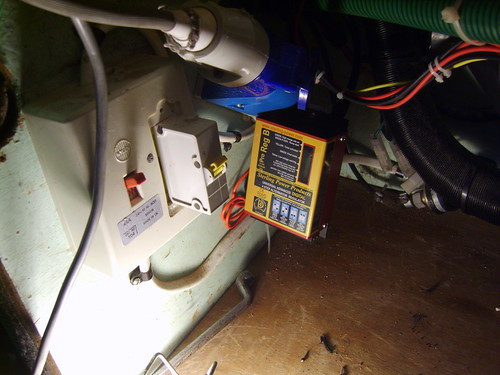
sterling regulator installed

The lazarette isn't actually that cramped as lazarettes go, but laying flat on your belly in one isn't the way they're meant to be employed. It might serve as a nice pilot berth, but I think I'll stow it with all the extra gear we'll have along. It'll do perfectly and I won't have to lay in it anymore. I'll use the soft bed in the aft cabin. I think I'll buy a new mattress to make it even more comfortable. And a large fan for those hot evenings in the Caribbean.